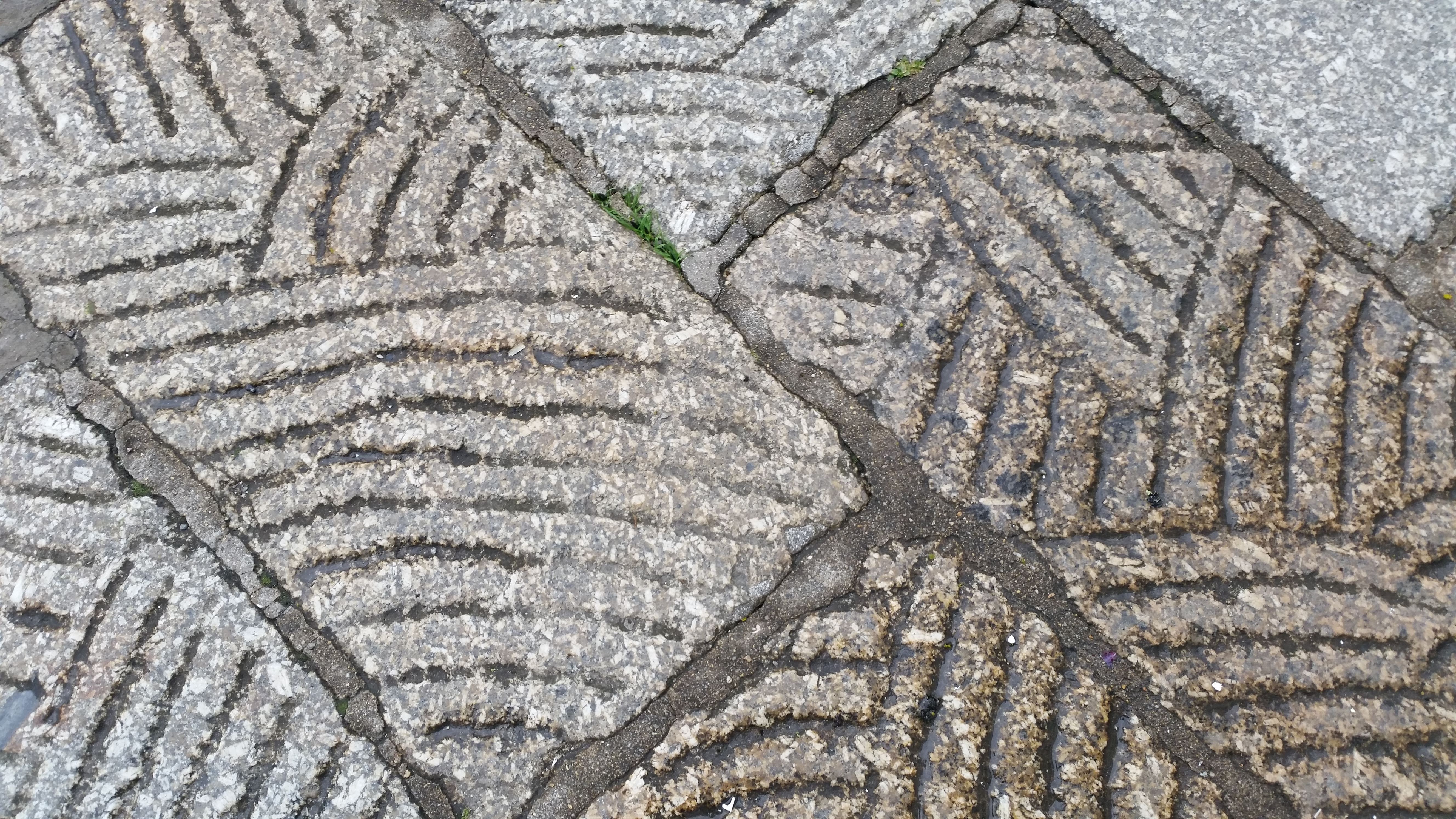
Natural stone paving in residential gardens involves decisions that extend well beyond choosing a material. The layout pattern, the substrate depth, the jointing method, and the gradient of the finished surface each affect how the paving performs over time — particularly in climates where frozen ground is a regular occurrence.
Poland's varied geology means that several domestic stone types are commercially available, alongside imported materials. Granite from the Sudeten region (primarily the Karkonosze area) has long been used in Polish urban streetscaping as sett. The same material is increasingly specified in private garden contexts due to its hardness and colour stability.
Stone types used in Polish residential paving
Granite sett (kostka granitowa)
The dominant paving stone in Poland at all scales. Available in cube format (approximately 8×8×8 cm or 10×10×10 cm) and rectangular planks. The grey tones of Sudeten granite — ranging from pale silver-grey to blue-grey — suit both formal and naturalistic garden designs. Water absorption is low (typically under 0.5%), making it highly resistant to frost damage when laid correctly.
Split-face sett has a textured surface that provides grip when wet; sawn sett is smoother but less likely to retain dirt in the surface irregularities. Both types are available through regional stone merchants across southern and southwestern Poland.
Sandstone slabs (płyty piaskowcowe)
Polish sandstone, particularly from the Carpathian foothills (the Magura sandstone formation), is widely available in irregular and cut slab formats. Warm ochre and buff tones contrast well with planting. However, sandstone's higher porosity — typically 5–15% compared to granite's under 1% — means it absorbs water and can fail mechanically after repeated freeze-thaw cycles if not sealed or laid on a frost-resistant sub-base.
Unsealed sandstone develops surface biological growth (algae, lichen) within two to three seasons in shaded locations, which some gardeners regard as desirable and others remove with diluted cleaning agents.
Limestone flags (płyty wapienne)
Less common in Polish domestic gardens than granite or sandstone, but present in formal garden designs — particularly where a light, warm palette is sought. Limestone is softer (Mohs 3–4) and acid-sensitive. It should not be used adjacent to clay soils with high organic content, as organic acids accelerate surface pitting. In sunny, well-drained situations it can remain stable for many years.

Bond patterns and their practical effects
The arrangement of paving units in plan has structural and visual consequences.
Running bond (wątek cegiełkowy)
Adjacent rows offset by half the unit length. Simple to lay and visually calm when stones have consistent dimensions. Directional — it reads as a line pointing along the path. Structurally adequate for low-traffic residential use on a sound sub-base.
Herringbone (jodełka)
Units laid at 45° or 90° in a V-pattern. Interlock between adjacent units distributes load laterally, making it the preferred pattern for driveways or areas subject to vehicle turning movements. It requires more cutting at perimeters. At 45° to the main axis it consumes approximately 10–15% more material than running bond due to edge cuts.
Random coursed (opus incertum)
Irregular shapes fitted together without a repeating unit. Common with natural riven stone where no two pieces are identical. Requires skilled laying to achieve stable contact between units and maintain consistent joint widths. Visually naturalistic and well-suited to informal garden paths where a designed irregularity is part of the character.
Technical reference points for Polish conditions
- Frost penetration depth in northern and northeastern Poland: commonly 80–100 cm; sub-base depth should exceed this where footings are continuous structures.
- For paving, a compacted aggregate sub-base of 15–20 cm on a geotextile separation layer is standard practice. The top of the sub-base should be above the level at which ground freezes.
- Minimum surface gradient for drainage: 1–2% away from buildings. Pooling water on paving accelerates freeze-thaw damage.
Sub-base and bedding
The visible stone is only as stable as the layer below it. In Polish residential gardens, two approaches are most common:
Bound construction (mortar bed)
Stone laid on a cement-sand mortar bed (typically 1:4 cement:sand by volume) over a concrete sub-base. Joints filled with pointing mortar. More stable under uneven loads but less forgiving of ground movement — if the sub-base settles differentially, pointing cracks. This approach requires that all drainage is managed below the slab level, either through gullies or a fall to an edge drain.
Unbound construction (sand/aggregate bed)
Stone laid on a compacted sharp sand or fine aggregate bed, joints filled with kiln-dried sand or fine aggregate. The surface can be lifted and relaid if a tree root heaves it or a pipe needs access below. It requires a contained edge restraint (steel or concrete kerb) to prevent lateral spread of the bedding layer.
Unbound paving with open joints allows precipitation to infiltrate rather than run off — a consideration in gardens where municipal drainage is at capacity or where planning guidance discourages additional impermeable surfaces.
Patterns specific to residential garden contexts
Garden paving differs from street paving in the level of foot traffic it receives and the degree of integration with planted areas. Several layout approaches are commonly used in Polish residential gardens:
- Terrace with planted joints: stone units set with 3–5 cm open joints seeded with creeping thyme (Thymus serpyllum) or mind-your-own-business (Soleirolia soleirolii). Works best in sunny, sheltered locations. The plants fill joints over two to three seasons and suppress weeds effectively once established.
- Stepping stone path: individual slabs set in turf or gravel with spacing calculated for a comfortable walking stride (typically 50–60 cm centre to centre). Uses stone efficiently and is visually light. Slabs need to be set slightly below turf level to allow mowing over them without blade contact.
- Formal grid with gravel infill: large cut slabs forming a grid with the squares between them filled with pea gravel or crushed granite. The gravel is permeable and self-draining; the slabs provide stable standing points without a fully paved surface.

Jointing
Joint material affects both the appearance and the drainage behaviour of a paved surface. In residential gardens:
- Kiln-dried sand — standard for unbound sett paving. Easy to apply, needs occasional topping up. Allows some water infiltration. Susceptible to ant displacement in warm months.
- Polymeric sand (piasek polimeryczny) — sand with polymer binders that set firm on wetting. Resists ant disruption and weed establishment better than plain sand. Requires careful application to avoid surface staining.
- Pointing mortar — used in bound construction. Various formulations available, including those with admixtures for improved flexibility in freeze-thaw conditions (typically polymer-modified). Rigid pointing can crack in ground subjected to seasonal movement.
References and further reading
- British Standards Institution. BS 7533: Guide to the structural design of pavements constructed with clay, precast concrete or natural stone units. Multiple parts. London: BSI.
- Kalinowska-Wichrowska, K. Naturalne materiały kamienne w architekturze krajobrazu. Poznań: Wydawnictwo Naukowe UAM, 2012. [In Polish]
- Wikimedia Commons, commons.wikimedia.org — images used under Creative Commons licences.
- Polski Związek Kamieniarzy, pkz.pl — stone standards and classification guidance.